Sample tube Aztec — 25×25 mm
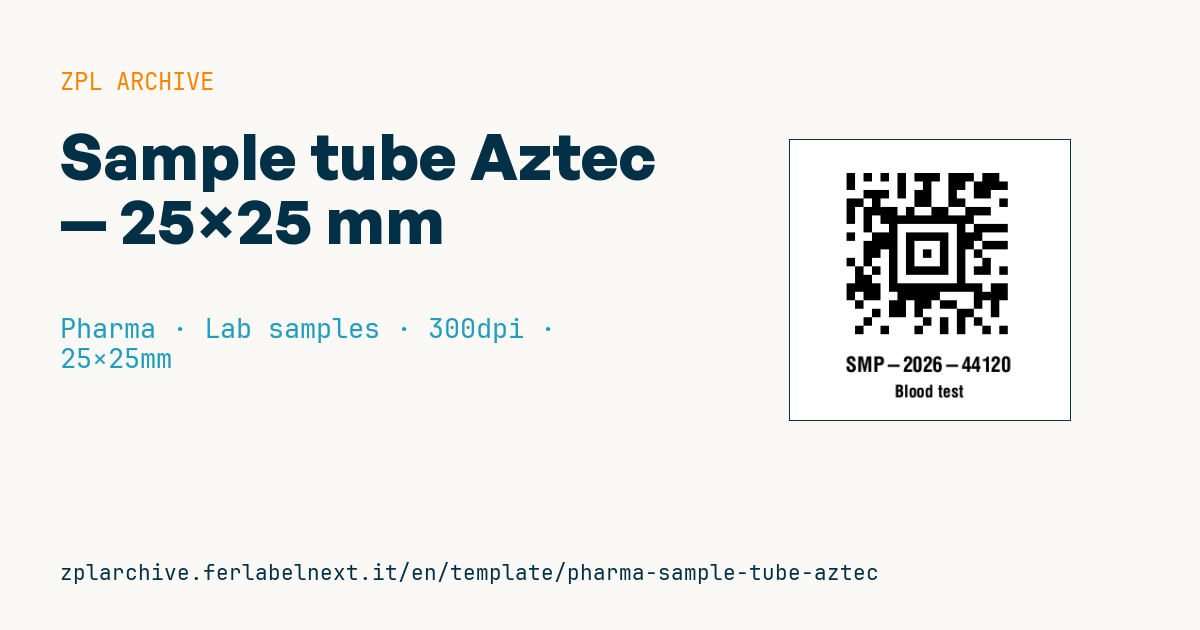
Micro label for lab tubes with a high-density Aztec code (readable even if partly covered), sample ID and test type. Compact.
Sample tube Aztec
25×25 mm @ 300 dpi. Aztec code (^BON) carrying the sample ID with ID + test type readable below. Aztec is robust on small, curved surfaces.
Placeholders
-
sample_id— sample ID -
test_type— test type (e.g.Blood test)
When to use it
This micro label is for places with almost no space: small tubes, cryovials, caps or the sides of containers in biobanks, research laboratories and clinical trial units. Aztec needs no quiet zone around the symbol and copes well with partial damage, so it stays readable on curved surfaces or with a corner covered. It is read with handheld 2D scanners or rack readers.
For samples stored at -80 °C or in liquid nitrogen you need cryogenic thermal transfer labels applied to a dry tube at room temperature before freezing.
Standards and requirements
The Aztec symbology is defined by ISO/IEC 24778. For the sample itself, unique identification and traceability requirements come from ISO 15189 in medical laboratories and ISO 20387 in biobanks. No standard mandates Aztec: it is a process choice to validate against the readers you have.
In ZPL the code is generated with ^BO: magnification sets the module size in dots, and the error control/symbol size parameter sets the correction percentage or a fixed symbol size. At 300 dpi avoid 1-2 dot modules.
Common mistakes
- Sending Aztec-labelled tubes to analysers that read only linear barcodes; check the instrument specification first.
- Applying the label to a tube that is already frozen or wet, so it falls off.
- Using direct thermal paper on samples kept for years.
- Printing the human-readable ID too small for a visual check when the code fails.
FAQ
Aztec or DataMatrix for tubes?
Both work in small spaces; DataMatrix is more common in rack systems, while Aztec needs no quiet zone. Pick the one your scanners read.
How many characters fit in such a small Aztec?
A compact symbol is enough for a sample ID of around twenty characters; more data needs more modules and therefore more space.
ZPL code
^XA
^PW295
^LL295
^CI28
^FO60,35^BON,9,N^FD{{sample_id}}^FS
^CF0,22^FO20,230^FB260,1,0,C^FD{{sample_id}}^FS
^CF0,18^FO20,260^FB260,1,0,C^FD{{test_type}}^FS
^XZ- Industry: Pharma
- Category: Lab samples
- DPI: 300
- Size: 25×25 mm
- Tags: Aztec, Patient, Pharma, Sterile
What this label contains
Barcodes
- Aztec
- 2D code that needs no quiet zone: tickets, transport and access passes.
Elements
- 2 text fields
- 2 variable fields to fill in
Variable fields
| Field | Description | Example |
|---|---|---|
sample_id | Sample ID | SMP-2026-44120 |
test_type | Test type | Blood test |
Format and printing
25×25 mm (0.98×0.98″) at 300 dpi: 295×295 dots. Square.
Compatible Zebra printers
You need a printer with a 2″ printhead at 300 dpi, for example:
- Zebra ZD411 (desktop)
- Zebra ZD611 (desktop)
Any Zebra printer with a wider printhead and the same resolution works too.
The code is written for 300 dpi: on a printer with a different resolution the label prints larger or smaller and needs rescaling.
How to use it
- Open “Customize placeholders” and enter your data in the variable fields listed above.
- Check the preview: it is rendered from the same ZPL code you will send to the printer.
- Download the .zpl file or copy the code and send it to the printer: with “Print” through Zebra Browser Print, or as a raw file to port 9100 if the printer is on the network.
- Load 25×25 mm labels and make sure the printer is set to 300 dpi. For a different size use “Duplicate & edit” and adapt the layout in the builder.
Edit it in the editor
To change the layout, use “Duplicate & edit”: the template opens in the online ZPL editor, where you modify it and save it to your account for free.
Related templates
- GS1 DataMatrix pharma — 25×10 mm (600 dpi) 600 dpi · Pharma · GS1 DataMatrix
- Patient check-in & appointment ticket — 80×150 mm 203 dpi · Pharma · Patient check-in & flow
- UDI medical device — 50×30 mm 300 dpi · Pharma · Drug packaging
- GS1 serialization DataMatrix — 40×25 mm 300 dpi · Pharma · GS1 DataMatrix
- Lab sample — 70×40 mm 300 dpi · Pharma · Lab samples
- Patient wristband — 200×25 mm 300 dpi · Pharma · Patient wristband
- Prescription label — 70×40 mm 203 dpi · Pharma · Drug packaging
- Sterile medical lot — 60×40 mm 300 dpi · Pharma · Drug packaging